It’s been a rough couple of weeks. After the shocking and seemingly sudden passing of David Bowie — one of our greatest, weirdest, and universally beloved artists — the great Alan Rickman went and died last Thursday. It’s a terrible loss.

More

It’s been a rough couple of weeks. After the shocking and seemingly sudden passing of David Bowie — one of our greatest, weirdest, and universally beloved artists — the great Alan Rickman went and died last Thursday. It’s a terrible loss.

Winter on Fire: Ukraine’s Fight For Freedom, the Netflix original just nominated for a best documentary Oscar last week, has two inescapable problems.
First, because the filmmakers are largely embedded with the Ukrainian resistance in 2013 and 2014 – and, understandably, because they want a narrative of heroic revolution that audiences can cheer – the film never really strays from a single set of viewpoints and experiences.

Don Hertzfeldt is a magician. Beginning with basic elements – rudimentary stick figures and bemused, detached commentary on modern life – he constructs elaborate universes. Their small details become invested with meaning and heartbreak, and the intentionally simple becomes endlessly complex.

In The Nightmare (2015), Room 237 director Rodney Ascher updates his enjoyable 2012 portrait of a handful of people with some … colorful interpretations of Stanley Kubrick’s The Shining, mapping similar themes onto an entirely different, much scarier vision.
The earlier film allowed ample, hilarious space for these Kubrick obsessives to present their wildly improbable visions of his true intent, but at the same time it served as an examination of the ways in which meaning is created.

There are many ways to approach science-fiction narratives, but one of the best has always been to create a lived-in world, filled with strange events and logic that often go unremarked upon by the characters. That’s always been part of the charm of the original Star Wars trilogy, for instance – you didn’t need to know what, exactly, a “nerf herder” or a “gundark” is, or where Ord Mantell is located, to get the points being conveyed.

At the end of 2015, The Hateful 8 barnstormed across select theaters, a whirlwind, even prior to its release, of debate. Positions were staked well in advance, and much of it came down to rather esoteric arguments about 70 mm projection and the future of film.
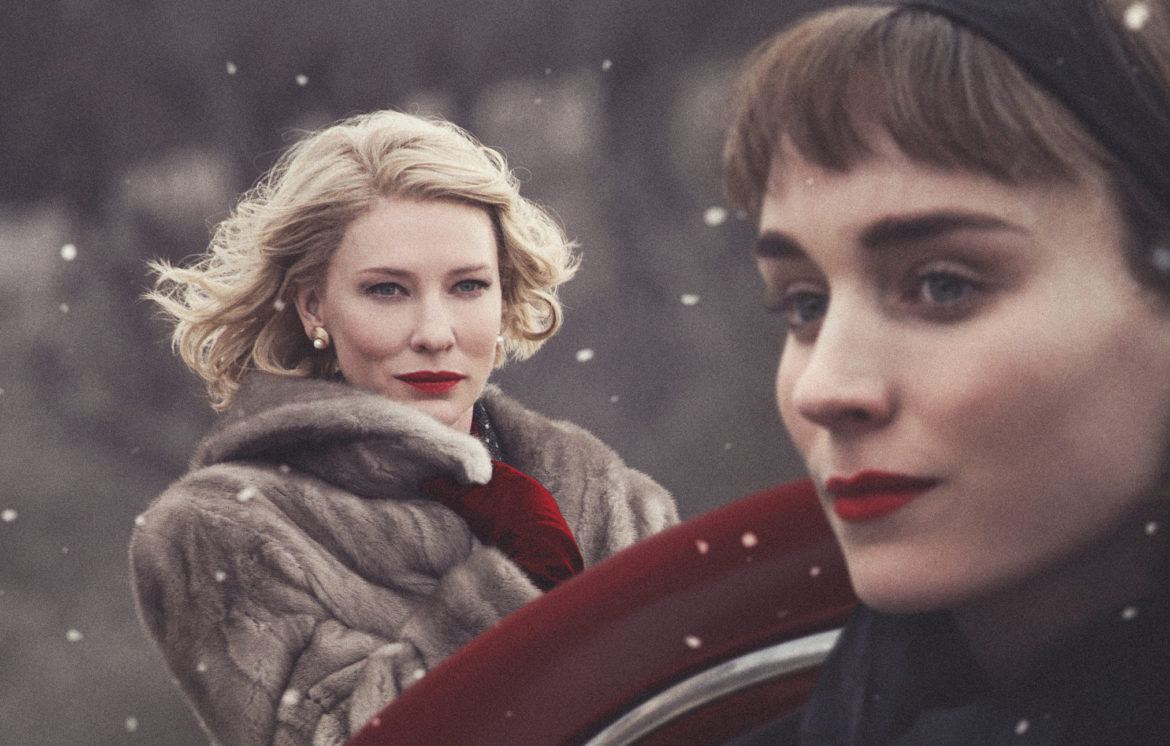
With Carol, Todd Haynes cements his place as his generation’s Douglas Sirk, the master of decorous, ravishing melodramas focused on the plights of women, their interior lives manifesting in heightened visual splendor and the weight of the world pressing them down.

What do you do when confronted with loss? Many of us flip through old photographs, read letters, watch videos from years gone by. Or, to bring it up to date, scroll through saved files of various kinds. Maybe you talk it through with those close to you, who understand and get the context and import and strange resonances.

John Crowley’s Brooklyn – an achingly earnest immigrant coming-of-age story, adapted by Nick Hornby from Colm Tóibín’s novel and featuring a revelatory performance from Saoirse Ronan – is a picture out of time.
Everything about it seems imported from an earlier period of film history: the total absence of cynicism, the self-assurance in its quiet moments, its elegant but understated framing, its close-ups on luminously lit faces, its resolute insistence on small personal dramas to provide context for the much larger ones that frame them all hearken back to another age.

In Felt, our lead Amy is haunted and, it would seem, somewhat damaged. We’re never told the exact nature of the trauma that has plunged her into a barely communicative fugue state, but it’s clear it was related to men and to some sort of (likely sexual) violation.